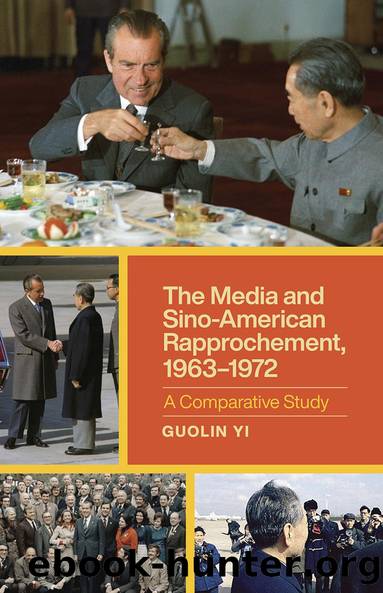
The Media and Sino-American Rapprochement, 1963-1972 by Guolin Yi
Author:Guolin Yi [Yi, Guolin]
Language: eng
Format: epub
Tags: Social Science, Media Studies, History, Asia, China, United States, 20th Century
ISBN: 9780807174661
Google: Z-PcDwAAQBAJ
Publisher: LSU Press
Published: 2020-11-11T05:17:19+00:00
Breakthrough via Secret Diplomacy
While signals through the public media did not produce timely effects, the two governments achieved a breakthrough by communicating through the third party. The 137th Warsaw Talk ended up never occurring after the break-off in February 1970. After that, Nixon and Kissinger tried to reestablish contact with Beijing through different channels. At first, they tried Lieutenant General Vernon A. Walters, the military attaché in Paris. Between July and September, Walters tried several times to tell his Chinese contact that he had an important message from Washington to Beijing. However, the Chinese official said only that he would inform his government that Walters had a message without making any further response.65 The Paris channel did not produce any result.
It was mainly through the Pakistani channel that Washington and Beijing achieved a breakthrough. As mentioned earlier, on October 25, Nixon had asked Pakistani president Yahya Khan to take his message to Zhou Enlai. Yahya visited China from November 10 to 15. On December 9, the Pakistani ambassador, Agha Hilaly, met with Kissinger and dictated Zhouâs âauthoritative personal messageâ to Nixon. Acknowledging Washingtonâs past messages from different sources, Zhou emphasized that it was âthe first time a proposal has come from a Head through a Head, to a Headâ and that he spoke not only for himself but also for Chairman Mao and Lin Biao. He also expressed his willingness to receive a special envoy of Nixon in Beijing to talk about the Taiwan issue.66
On December 16, Kissinger summoned Hilaly and asked him to tell the Chinese that Washington was âprepared to attend a preliminary meeting at an early dateâ to make arrangements for sending a U.S. delegation to Beijing for higher-level talks. He stated that the talks would not be âconfined to the question of Taiwanâ but would address all issues concerning the improvement of relations between the two governments. He also said that the Chinese request for withdrawing U.S. forces from Taiwan was not hard to comply with because there were no military forces there except âadvisory and training missions.â67
Zhou Enlaiâs reply came through Romanian ambassador Corneliu Bogdan on January 11, 1971. Even though he insisted that the U.S. âoccupationâ of Taiwan was the only âoutstanding issueâ between the two governments, Zhou wrote that Beijing was ready to receive a U.S. special envoy if the United States had a âdesire to settle the issueâ and a âproposal for its solution.â More importantly, he added, since President Nixon had visited Bucharest and Belgrade, he would also be welcome to visit Beijing. It was the first time Zhou formally expressed Beijingâs willingness to receive the American president in China. Unfortunately, Nixon and Kissinger interpreted his message as Chinaâs insistence that the U.S. government agree to the Chinese principle on Taiwan as a prerequisite for negotiations. Nixon wrote a note on Kissingerâs memo: âI believe we may appear too eager. Letâs cool it. Wait for them to respond to our initiative.â68 As the two sides were bargaining over the agenda through
Download
This site does not store any files on its server. We only index and link to content provided by other sites. Please contact the content providers to delete copyright contents if any and email us, we'll remove relevant links or contents immediately.
| Anthropology | Archaeology |
| Philosophy | Politics & Government |
| Social Sciences | Sociology |
| Women's Studies |
The Secret History by Donna Tartt(19092)
The Social Justice Warrior Handbook by Lisa De Pasquale(12190)
Thirteen Reasons Why by Jay Asher(8912)
This Is How You Lose Her by Junot Diaz(6889)
Weapons of Math Destruction by Cathy O'Neil(6281)
Zero to One by Peter Thiel(5802)
Beartown by Fredrik Backman(5756)
The Myth of the Strong Leader by Archie Brown(5509)
The Fire Next Time by James Baldwin(5447)
How Democracies Die by Steven Levitsky & Daniel Ziblatt(5219)
Promise Me, Dad by Joe Biden(5154)
Stone's Rules by Roger Stone(5088)
A Higher Loyalty: Truth, Lies, and Leadership by James Comey(4964)
100 Deadly Skills by Clint Emerson(4926)
Rise and Kill First by Ronen Bergman(4790)
Secrecy World by Jake Bernstein(4753)
The David Icke Guide to the Global Conspiracy (and how to end it) by David Icke(4720)
The Farm by Tom Rob Smith(4514)
The Doomsday Machine by Daniel Ellsberg(4490)
